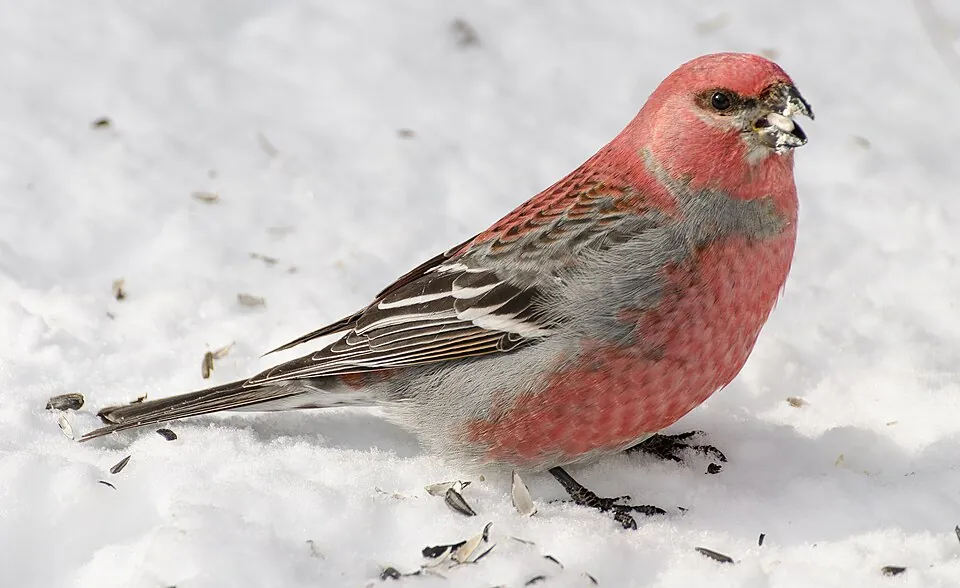
Photo: Per / CC BY-SA 2.0
Winter 2026–27 · Official forecast, in plain English
Winter Finch Forecast 2026–27 for the Northeast
The Finch Research Network expects siskins, Red Crossbills, and some Evening Grosbeaks and Purple Finches in the Northeast this winter — mostly in the woods, not at the feeder. It does not call for a big redpoll or Pine Grosbeak flight, or a major push into the Southeast. Here is what the official forecast actually says.
Every September, people who sell seed and people who buy cameras start talking as if New England is about to be buried in rare finches. Sometimes that is what the forecast says. This year, you should read the original before you rearrange the yard.
The 28th annual Winter Finch Forecast was written by Tyler Hoar for the Finch Research Network, posted on September 25, 2026, and dated September 27. It is a crop-and-movement outlook for Ontario, Quebec, the Maritimes, the northeastern United States, and the Great Lakes, with notes on points farther south. It is not a promise that a given bird will visit a given feeder. The official page is the source; this article is a plain-English walkthrough of what it says about the Northeast, with a look at how early November feeder counts line up so far.
The one-paragraph version
Seed crops are good from central Ontario east into the Maritimes and the northeastern United States, and again from British Columbia to Alaska. They are mostly poor from western Manitoba to Alberta. Those poor central crops should push finches toward the East (and the far West), but because the Northeast itself has a very good eastern white pine and northern white cedar crop, and a fair-to-good spruce crop, the birds that arrive are likely to spend more time in the woods than at feeders. The forecast does not expect big irruptions of any finch into the southeastern states.
What the trees are doing
Hoar’s general forecast is built on mast: the seed and fruit crops that boreal and northeastern forests put up in a given year. This winter, eastern white pine and northern white cedar are described as very good. Eastern hemlock and the three spruces (black, red, and white) are variable, with fair-to-good areas and red spruce the strongest of the three — especially inland, away from the Maine and Maritime coasts. Maples lean good. Oak and beechnut crops are quite good in the East. Birch is good in the eastern boreal and thinner toward the central boreal. Mountain-ash looks quite good across much of the boreal, with fairer conditions in the central belt and a poor crop near Tadoussac, Quebec. Pin and chokecherry lean poor to fair.
Spruce budworm outbreaks from Ontario eastward were widespread again in the summer of 2026, which the forecast says provided ample food for Evening Grosbeaks, Pine Siskins, Purple Finches, and the so-called budworm warblers during the breeding season. A separate, important detail for crossbills: there has been a widespread pine failure on limber, whitebark, pinyon, and ponderosa pines in the interior mountain West, and Type 2 Red Crossbills started moving west-to-east in July and August.
Last winter, 2025–26, was a mixed irruption year in the East: a solid flight of Evening Grosbeaks, Pine Grosbeaks, and Purple Finches, and only a small flight of Pine Siskins. The forecast says this year looks mixed again, just in a different way.
Species by species, for the Northeast
The notes below paraphrase the official individual forecasts. If a detail matters to you, read Hoar’s wording on the Finch Research Network page.
Pine Siskin
This is one of the headline birds. Siskins were present in small numbers in the East over the summer. In the weeks before the forecast, Tadoussac, Quebec, had counts in the hundreds on several days, and Hawk Ridge, Minnesota, had several days over 1,000. The Northeast has a very good northern white cedar crop (and some good hemlock), which siskins favor, plus that very good eastern white pine crop. The last time the East had a great white-pine year, in 2023–24, siskins were plentiful from January into spring.
The forecast expects the good crops to hold a sizable irruption in the northeastern states, with a small-to-moderate flight to the Southeast also possible. It is explicit, though, that siskins, both crossbills, and even Purple Finches will be found in the forests more than at feeders this year. If they do come to the yard, they prefer nyjer in a silo or sock, and they will also take black-oil sunflower in a tube. See the seed buying guide for currently sold nyjer bags.
Red Crossbill
Expect good numbers from Algonquin Provincial Park through the southern Maritimes and the northeastern United States. Type 12 should dominate the usual conifer haunts in the northeastern U.S. and southeastern Canada at the start of winter. A significant Type 2 irruption has already moved west to east because of the failed western pines; Hawk Ridge and Whitefish Point both reported larger-than-normal numbers from August onward. A few Type 4s have come east with them, and a few Type 1s should be scattered, especially in western Massachusetts, southern New York, and south into the mountains of West Virginia and North Carolina.
As winter goes on, more Type 2s are expected to reach the northeastern United States. If numbers build and cone crops are depleted, a late-winter movement down the coast — Long Island, Cape May, Delaware, and points south, especially Type 12 — is possible, as sometimes happens. Identifying types usually requires a recording of the flight call; the forecast invites people to upload recordings to eBird or email them to the Finch Research Network. This is a walk in the pines, not a feeder event.
White-winged Crossbill
After a winter (2025–26) when most White-winged Crossbills were in the western boreal, the pendulum has swung back east somewhat. An excellent spruce crop is narrower this year: Alaska into parts of British Columbia, and again in the East, with much less in the middle of the boreal. An influx reached southeastern Canada, the northeastern United States, and the Great Lakes in July, and some birds stayed and appeared to nest where the spruce crop was good. The forecast expects White-winged Crossbills in the far West and the far East, with a small-to-moderate push in the East as remaining birds gravitate toward interior Ontario, Quebec, and the northeastern United States. Scattered flocks may wander the Great Lakes, including to cone-laden ornamental spruces in towns.
Evening Grosbeak
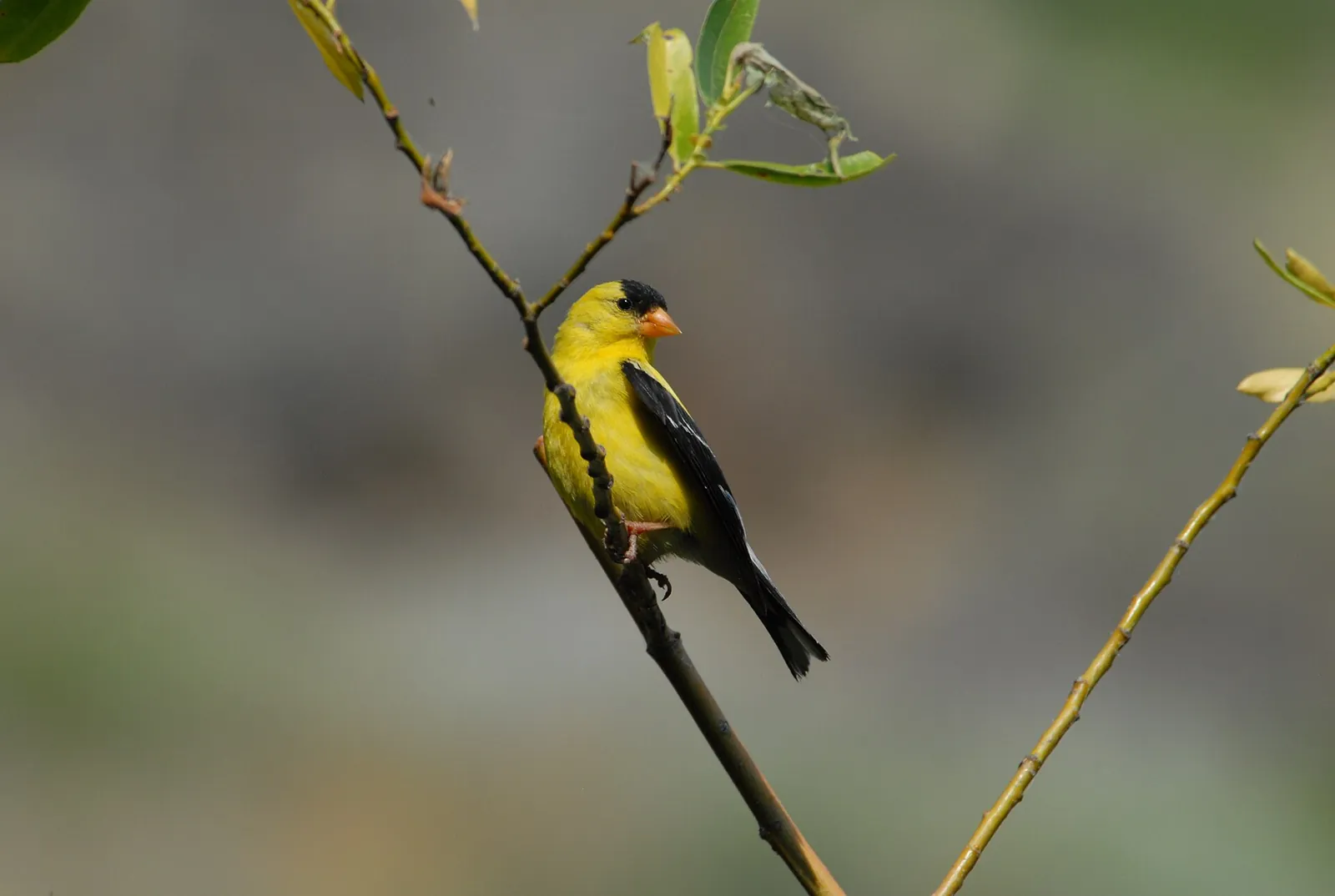
The eastern budworm outbreak has lasted a decade or more in many areas, and the forecast links that to a local increase in this budworm-loving finch. Cherry crops after the budworm season are not good this year, but mountain-ash is, and that is expected to hold some grosbeaks (and Purple Finches, and most Pine Grosbeaks) farther north. The Northeast has had at least small-to-moderate Evening Grosbeak irruptions in four of the last six winters (2020–21, 2022–23, 2024–25, and 2025–26).
This year, small-to-medium flocks should be findable in the better grosbeak haunts of southeastern Canada (including around Algonquin and towns to the south), the Great Lakes, and the northeastern United States. A small movement south of the boreal — to southern New York, Pennsylvania, and Massachusetts — is described as quite possible. At platform feeders they prefer black-oil sunflower; away from feeders they look for maple and ash trees still holding seeds.
Purple Finch
There were back-to-back eastern flights the last two years: moderate in 2024–25, small to moderate in 2025–26. The forecast asks, given spruce budworm and a perceived uptick in numbers over the past decade, whether annual flights are becoming more common again, and answers “maybe.” Many Purple Finches are expected to move into eastern Canada, the Great Lakes, and the northeastern United States to take advantage of good spruce, great eastern white pine, and mountain-ash. When those northern foods are good, birds tend to stay farther north. Any flight onward to the Mid-Atlantic and southern states, if it materializes, is expected to be late and small. At feeders they prefer black-oil sunflower.
Early Project FeederWatch lists for November 1–13 already show Purple Finches at 28.8 percent of New Hampshire sites and 24.3 percent of Maine sites, and at 13.2 percent in Vermont. They did not appear in the published top 20 for Massachusetts, Connecticut, or Rhode Island in that window. That is a start, not a season. Details are in the November feeder report.
Redpoll
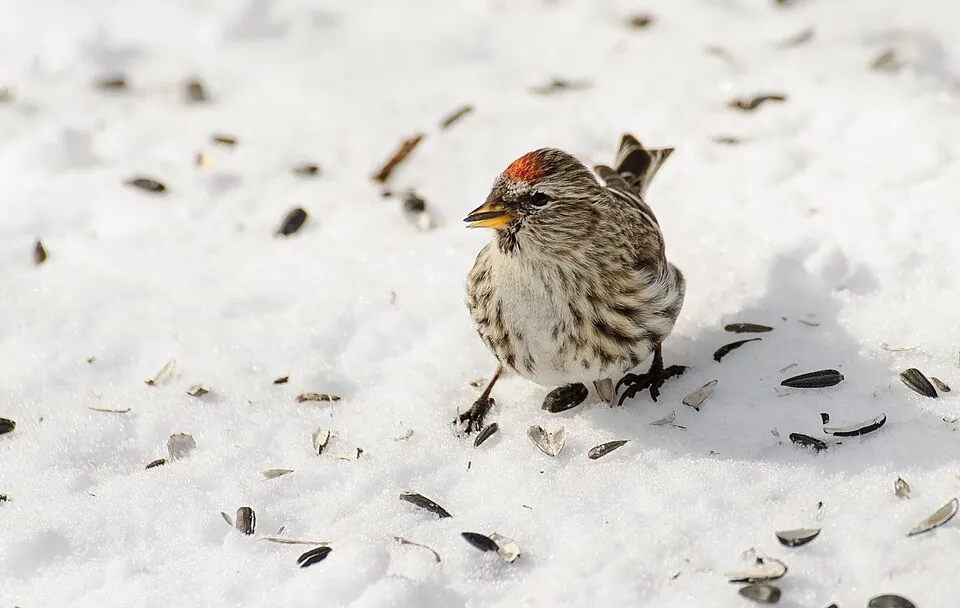
This is the bird retailer blogs love to promise, and it is not the headline this year. Birch crops look mixed, but parts of Quebec and the Maritimes seem quite good, which the forecast says should be a sufficient cushion to hold most redpolls north in Canada. A small-to-modest irruption might reach the western Great Lakes and perhaps northeastern border areas, but Hoar notes that redpolls have become harder to predict over the last 15 to 20 years. Last year the forecast called for at least a moderate invasion after August reports in the northeastern United States, and it never really materialized.
The official wording is direct: “We do not expect a big flight this year, but a small flight wouldn’t surprise us either, especially in the western Great Lakes region.” If a sizable flight did appear, a few paler “Hoary” birds could be mixed into larger flocks. (In 2024, Common, Hoary, and Lesser Redpoll were lumped into a single species, Redpoll.) Watch birches, weedy fields, and feeders with nyjer and black-oil sunflower. Do not buy a new gadget on the promise of a once-in-a-decade redpoll winter.
Pine Grosbeak
Not much of a flight is expected, after last year’s modest irruption into the Great Lakes and northeastern United States. A robust American mountain-ash crop across much of the boreal should hold birds north. Very small numbers could still show up in traditional areas of southeastern Canada and the border states. Birds that do wander south will look for European mountain-ash and small ornamental crabapples, even in towns, and at feeders they prefer black-oil sunflower on a large platform or hopper.
Three birds that often move with the finches
The forecast also covers three non-finch passerines whose movements are often linked to the same crop cycle.
Blue Jay. An above-average flight is expected along the north shores of Lakes Ontario and Erie, after a very large flight at Hawk Ridge, Minnesota — including more than 13,000 Blue Jays on September 16, and several days of 1,000-plus counts. The beechnut and acorn crop is quite good and widespread in the East, so some of those birds should move eastward. Jays already dominate early New England feeder lists; this is about movement along the Great Lakes, not a new backyard species. They cache sunflower and peanuts.
Red-breasted Nuthatch. Last year this species irrupted in very large numbers east to the Gulf Coast. This year, good cone crops in the East are expected to hold many birds north, and the forecast does not expect a large flight to the southeastern United States. At feeders they prefer black-oil sunflower, peanuts, and especially suet. Early November FeederWatch lists already show them at 42.9 percent of Maine sites, versus 22.5 percent in New Hampshire and 19.1 percent in Vermont, and they did not appear in the published top 20 for the three southern New England states.
Bohemian Waxwing. A fairly robust mountain-ash crop should hold most birds north. Some will still appear in traditional areas of southeastern Canada and the eastern border states, but the forecast does not expect much of a flight south of those areas.
What this means for a New England yard
Set up the station for the regulars, not for a miracle. Black-oil sunflower, suet, millet on a tray, and a nyjer tube will feed the birds that are already in the November counts and will still be useful if a siskin or grosbeak drops in. Then go look in the pines, hemlocks, and cedars. The forecast is unusually clear on that point: this is a woods year more than a feeder year.
Follow the rest of the winter on eBird, on the Finch Research Network site, and in later FeederWatch windows. Forecasts are educated outlooks, and last year’s redpoll call is a useful reminder that the birds do not always cooperate. The winter feeding guide covers seed, water, placement, and hygiene for the birds that will show up either way.
Sources
- Tyler Hoar, Finch Research Network, Winter Finch Forecast 2026-2027, posted September 25, 2026, and signed September 27, 2026, Oshawa, Ontario. This is the 28th annual forecast; the first was posted to the Ontbirds and Birdchat listservs in 1999.
- Project FeederWatch / Cornell Lab of Ornithology counts for November 1–13, 2026, as compiled by Stacker on November 16, 2026, used here only to note early Purple Finch and Red-breasted Nuthatch site percentages. Full tables are in our November feeder report.
- eBird, which the official forecast recommends for following finch wanderings through the fall and winter.